
- Home
- /
- The National Register
- /
- Finnish Literature Society’s Folklore index cards
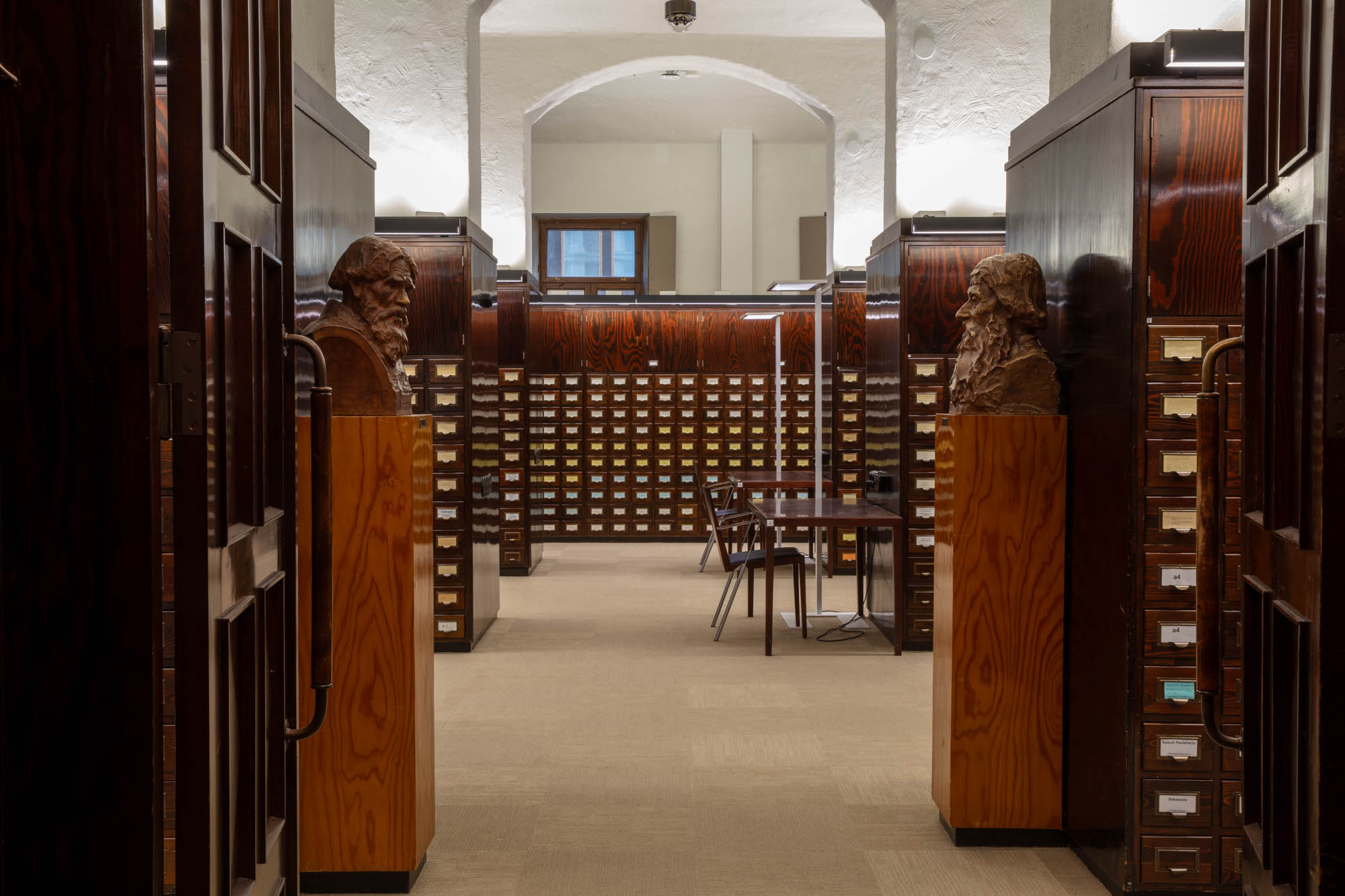
Finnish Literature Society’s Folklore index cards
Year of induction: 2024
Custodian: Finnish Literature Society,
Since 1831, the collection and preservation of oral folk poetry have been one of the functions of the Finnish Literature Society (SKS). As a result of this work, the society has amassed extensive collections of folklore. The most prominent part of these collections is the pinewood cabinets of folklore index cards, which give the interior of SKS’s archives its unique atmosphere. The Finnish Literature Society’s folklore index card cabinet contains approximately three million cards organized by genre, subject, geographical origin, and collector of the item of folklore or oral tradition. The index cards are an integral part of the national documented cultural heritage, as well as the history of scholarly practice in the humanities in Finland and Finnish national identity.
The folklore index cards are the result of tens of thousands of people collecting and sharing oral traditions and the history of learning related to studying folk poetry in Finland. The index cards, created for the oral lore genres, were the cornerstones of folk poetry studies (later known as folklore studies). This was influenced by a theoretical approach developed in the late 1800s, the historic-geographic method, internationally known as “the Finnish method.” According to this method, folklore texts were examined comparatively in terms of their geographical region and historical development by determining their original form and distribution. This method became an international paradigm in the early 1900s and influenced folklore studies until the 1960s. The historic-geographic method was the most successful export product of Finnish research in the humanities, accelerating the establishment of folklore studies as its own field of science in various institutions around the world. The folklore index card cabinet of SKS’s archives is the most prominent manifestation of this scientific thinking and archive classification. The index cards were constructed on the basis of genres in oral tradition and the subjects who collected folklore items over the decades.
In the 1930s, SKS began collecting information on genres, such as incantations, proverbs, and fairy tales from manuscripts sent to the society, and copying the information onto separate cards. The wooden index card cabinet in SKS’s archive reading room was completed in 1950 as part of the architect Paavo Riihimäki’s comprehensive renovation of the archive premises, carried out with funds donated by the state. The folklore index cards continue to be an essential avenue for the use of national heritage materials. They are utilized as source material in research and dissertation work across multiple academic disciplines. The folklore index cards represent part of our ever-changing cultural heritage, as the ways in which the index cards are used also change as we gain deeper knowledge of the world. Every customer who utilizes the index cards in SKS’s archives is informed about its history and creation and the ways of scholarly thinking that influenced it. Insights from the folklore index cards are challenged in customer encounters by discussing matters such as what kinds of interpretations of the past can be made based on the folklore index cards. Thus, the index cards help generate new perspectives on science and art and provide a window to the history of mentalities.